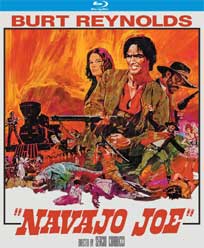
 NAVAJO
JOE (1966) Blu-ray
NAVAJO
JOE (1966) Blu-rayDirector: Sergio Corbucci
Kino Lorber Studio Classics
NAVAJO
JOE (1966) Blu-rayBefore moaning, “Oh no, Burt Reynolds as an Indian!”, understand that NAVAJO JOE is a highly recommended Spaghetti Western directed by the prolific Sergio Corbucci, the man behind DJANGO and THE GREAT SILENCE. The legend is that Reynolds agreed to star in the production as he was under the impression that Sergio Leone would be directing (he must have saw what Leone did for Clint Eastwood’s career) but it was too late to back out after learning Corbucci would be at the helm. Well, Reynolds did not become a household name because of Italian-made westerns, but he would still go on to be one of the biggest movie stars of all time, and although he often publicly denounced this film as his worst, it’s far from that and extremely entertaining.
A band of downright merciless bandits led by Duncan (Aldo Sambrell, THE GOLDEN VOYAGE OF SINBAD) and his blonde brother (Lucio Rosato, THE BARBARIANS) kill peaceful native Indians in cold blood, retaining their scalps for profit. One of the poor women they happen to murder and mutilate is the mate of a Navajo Indian named Joe (Burt Reynolds, SMOKEY AND THE BANDIT), who hastily makes it his mission to get revenge. When Duncan and his small army are told that the scalps are no longer collected by authorities, they make a deal with the corrupt Dr. Chester Lynne (Pierre Cressoy, HERCULES VS. THE GIANT WARRIOR) to steal a large amount of money on its way to the town of Esperanza via a passenger train. Joe is able to thwart the heist (after Duncan and company massacre everyone on the train, sans a small child), but when the town realizes these destructive killers will soon be attacking, they make a deal with the brave Indian to protect them and their precious loot.
The plot is simple enough; a loved one is murdered, a robbery is attempted, a town is threatened and a brave hero must come forth to face up to the bad guys. But that’s just fine, because NAVAJO JOE works well in its action-packed 92 minutes, shot mostly outdoors among beautiful Spanish landscapes and boasting some truly scrumptious cinematography by Silvano Ippoliti (CALIGULA). It doesn’t waste much time with a romantic subplot, though there is a rather half-baked relationship between Joe and the pleasant servant Estella (played by stunning Italian-born brunette Nicoletta Machiavelli, KISS THE GIRLS AND MAKE THEM DIE). This is basically old fashioned “good guys vs. bad guys” (though the good guys are mainly Joe, Estella, a banjo player and a trio of showgirls), with an extremely high body count and a surprising amount of violence for the mid 1960s (scalpings, stabbings, forehead carvings, gunshots in the face, etc.).
Tan-painted and wearing a jet-black long-banged wig that almost makes him look like he should be playing with a 1960s Garage Rock band, Reynolds suitably deadpans through the role of Joe in traditional no-nonsense cinematic tough guy mode; athletic and smart enough to outwit his many adversaries. He may not have had fun making the film (reportedly, he left the set at one point to do a TV commercial) but it certainly looks like he did, and he also carried out most of his own stunts. Sambrell, an actor you’ve seen dozens of times, usually in the background of Sergio Leone westerns, is great as the cold-blooded Duncan, exemplifying pure evil in his facial expressions alone. Fernando Rey (THE FRENCH CONNECTION) is pretty much wasted as the priest, Father Rattigan, but has at least one memorable scene with Sambrell. For fans of Euro exploitation, the crew is actually more interesting than the cast, as director Fernando Di Leo (SLAUGHTER HOTEL) served as one of the writers, future cannibal movie maven Ruggero Deodato was an assistant director and Ennio Morricone supplied the distinct score (“Navajo Joe” is even given a vocal theme) under the pseudonym “Leo Nichols.” As one of the film’s biggest champions, Quentin Tarantino would later use some of the music for his KILL BILL VOLUME 2 soundtrack.
Originally released theatrically in the U.S. by United Artists, Kino Lorber thankfully continues to extract from the extensive MGM film library by granting us NAVAJO JOE on Blu-ray. Previously available on DVD from MGM in an edition that quickly went out of print, the film looks great here, presented in 1080p HD in its original 2.35:1 Techniscope aspect ratio. The transfer provides rich colors, excellent detail and a solid, filmic grain structure. Black levels are strong and fleshtones are natural, and all this goodness is wrapped up in a blemish-free image that showcases the immaculateness of the film’s original elements. There’s only one audio option, a clean-sounding English DTS-HD Master Audio 2.0 track (with Reynolds’ actual post-synced voice) which renders Morricone’s score well and also has good dynamic range. No subtitle options are included.
A commentary is included with film historian and Senior Vice President of theatrical releasing at Kino Lorber, Gary Palmucci, who gives occasional comments and facts about the film, focusing mainly on the film’s legendary composer. A trailer for NAVAJO JOE is included, as well as trailers for WHITE LIGHTNING, GATOR and MALONE;, all Burt Reynolds titles available on Blu-ray from Kino Lorber. (George R. Reis)